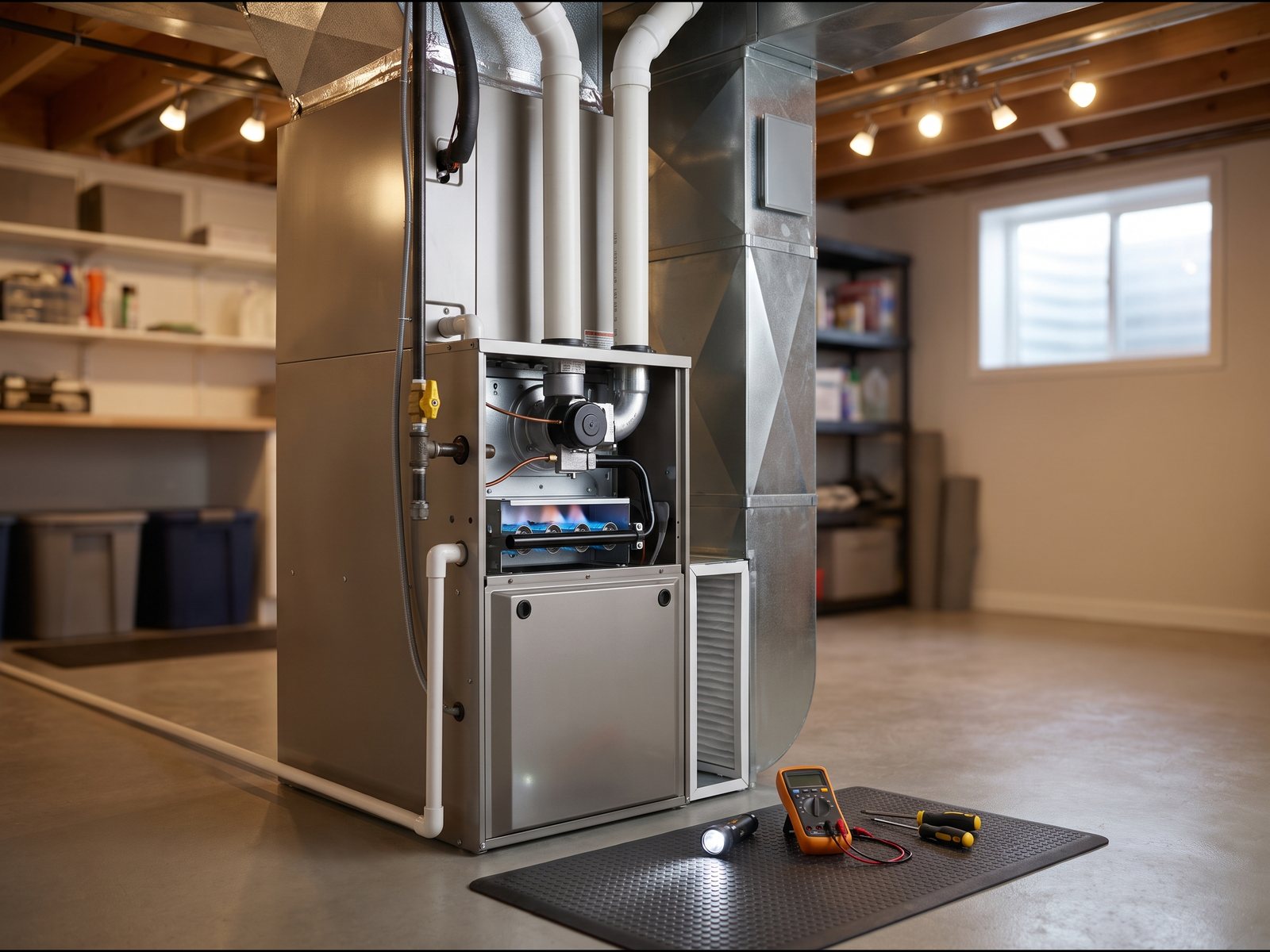
Who repairs furnaces in Vancouver, WA
Alex, the owner of 777 HVAC, diagnoses and repairs gas and electric furnaces for homes in Vancouver and nearby Clark County. The person who takes your call is the person who finds the fault and fixes it. Visits run Monday to Friday, 7am to 5pm; 777 HVAC does not run an after-hours emergency service.
Common furnace problems and their usual causes
One symptom can come from several faults, which is why a visit starts with testing rather than a guess. These are the usual suspects:
- No heat at all. Thermostat settings or dead batteries, a tripped breaker or furnace switch, a dirty flame sensor, a failed igniter, a blown control fuse, or a pressure switch or inducer motor fault.
- Cold air from the vents. The thermostat fan set to On instead of Auto, burners shutting off on a safety limit (often a clogged filter or a blocked return), or an ignition or flame-sensing fault.
- Starts, stops, starts again. Overheating from restricted airflow, a dirty flame sensor, a badly placed thermostat, or a furnace that is too big for the house.
- Runs all the time but rooms stay cool. Leaky or disconnected ducts, a weak blower, a dirty filter, or a furnace that is too small.
- New noises. Squealing usually points to the blower motor or belt. A bang at start-up can be delayed ignition and needs a technician soon. Rattles are often a loose panel or the inducer.
- Water around the furnace. High-efficiency (90% and up) furnaces make condensate, so a blocked drain, trap or condensate pump is the usual cause.
A dusty smell for a few minutes on the first cold day is normal. A smell that keeps coming back, or anything that smells electrical, is not: turn the furnace off and call.
What happens on a repair visit
- When you book, describe what the furnace is doing and when it started. A photo of the model sticker or any flashing light code helps.
- Alex checks the thermostat’s call for heat, the filter and the airflow, then watches the furnace go through its start-up sequence and reads any fault codes.
- The parts involved in the fault are tested, not swapped on a hunch: igniter, flame sensor, pressure switch, inducer, limit switches, blower and control board, as the symptom calls for.
- You get the repair price in writing before any work starts. Nothing is replaced until you say yes.
- After the repair the furnace runs a full heating cycle so you can see it working before Alex leaves.
What a repair visit costs
Repair visits carry a diagnostic charge that covers the trip and the time it takes to find the fault properly. You are told the amount when you book, never after. The FAQ explains how pricing works. Many repairs are finished in one visit, and several common failures (igniters, flame sensors, capacitors) are inexpensive parts.
Deciding between repair and replacement
Age alone does not decide whether a furnace should be replaced. A sound furnace with one failed part is usually worth repairing. Replacement starts to make more sense with a cracked heat exchanger, repeated major failures, or a repair that would cost a large share of a new system.
When that is where things stand, you get both options priced, and estimates on replacements are free. Many homeowners compare a new furnace with a heat pump at this point, since a heat pump also cools.
Safety first
If you smell gas, leave the house first. Then call 911 and NW Natural’s 24-hour emergency line, 800-882-3377, from outside, and don’t flip switches or use a phone indoors. That is NW Natural’s own instruction (nwnatural.com).
If a carbon monoxide alarm goes off, get everyone outside and call 911. And if the furnace keeps shutting itself off, a safety control is doing its job: note what happened and book a visit instead of resetting it again and again.
A recent repair, in the customer’s words
“Alex was prompt, honest, caring, respectful, and does great work. He went above and beyond to find a universal board to repair our old heater that was made in the times of Noah.”
Common questions
Why is my furnace blowing cold air?
Check the thermostat first: with the fan set to On rather than Auto, it blows between heating cycles. Otherwise the burners may be shutting off on a safety limit, often because of a clogged filter or blocked return, or there is an ignition or flame-sensing fault. A short burst of cool air at start-up is normal; cold air that lasts needs a diagnosis.
Is there a charge to diagnose a furnace?
Yes. Repair visits have a diagnostic charge for the trip and the time to find the fault. You are told the amount when you book. Estimates for a replacement furnace are free.
Do you repair furnaces after hours or on weekends?
777 HVAC works Monday to Friday, 7am to 5pm, with no after-hours emergency service. If your heat is out, call and you will get the earliest opening; if that is not soon enough, you will be told straight away so you can call someone else.
Should I keep restarting a furnace that shuts down?
No. Repeated shutdowns usually mean a safety control is responding to a fault. Note what you saw and arrange service rather than cycling the equipment again and again.
What is the $5,000 rule for furnaces?
A rule of thumb you will see online: multiply the furnace’s age in years by the repair price, and if the result is over $5,000, replacement is worth pricing. It is a starting point, not a verdict. A sound furnace with one failed part is usually worth repairing, and when it is close, you get both options priced.
How old is too old to repair a furnace?
There is no set age. A sound furnace with one failed part is usually worth repairing; a cracked heat exchanger, repeated major failures or a repair that costs a large share of a new system usually is not. You get both options priced so you can decide.